For defining the priorities of action and choice of countermeasures, it is above all necessary to take the following indicators into account:
– installation of electrical equipment;
– financial value of the electrical equipment and cost of decontamination/disposal;
– type and amount of insulating liquid;
– concentration of PCBs in electrical equipment;
– state of degradation and effects on the functionality of the electric equipment;
– possible coincidence between decontamination activities and other maintenance activities;
– environmental impact associated with possible failures and consequent losses of contaminated oil.
The following are countermeasures for the “Insoluble deposits (sludge)” criticality, a result of the recommendations of IEC 60422 (Table 5, page 31) improved according to state of the art and the use of BAT and BEP:
Transformer desludging
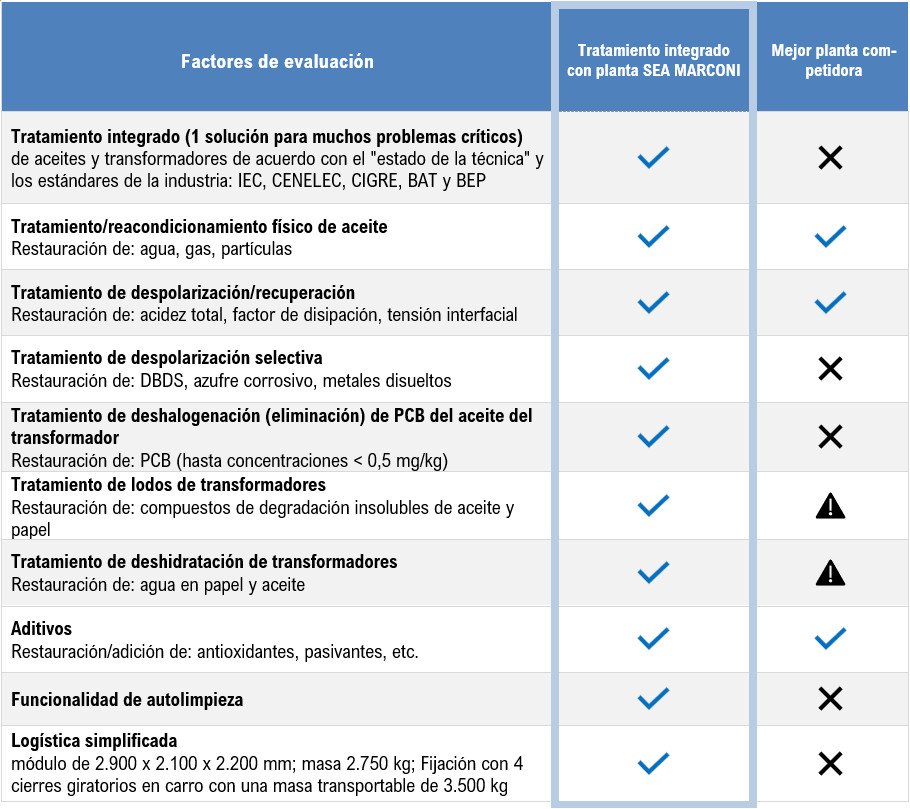
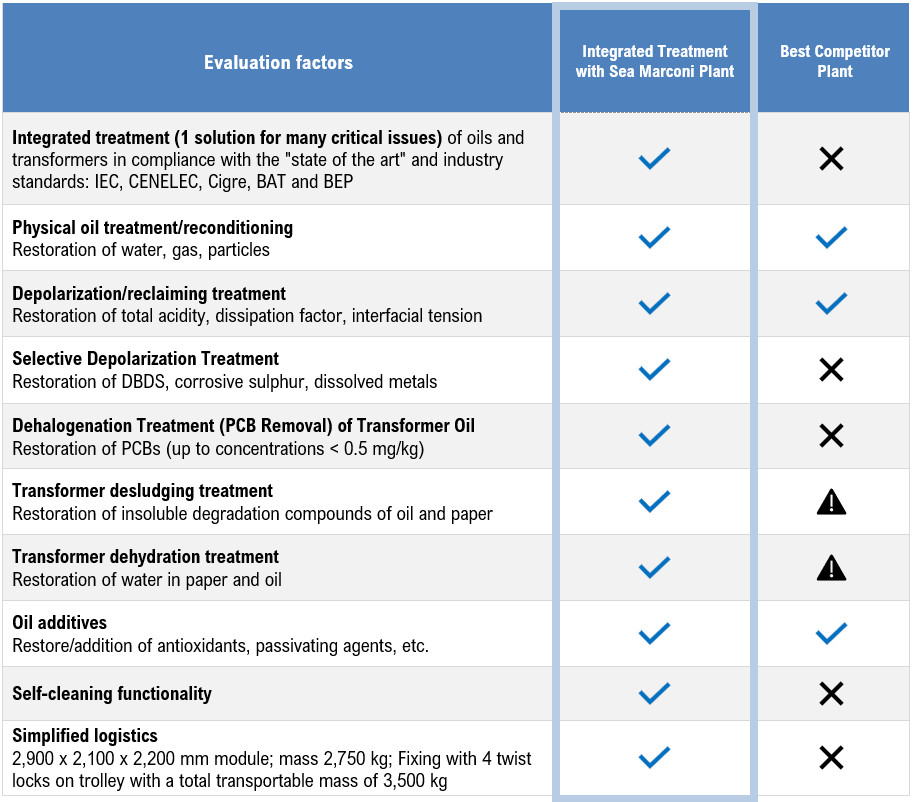
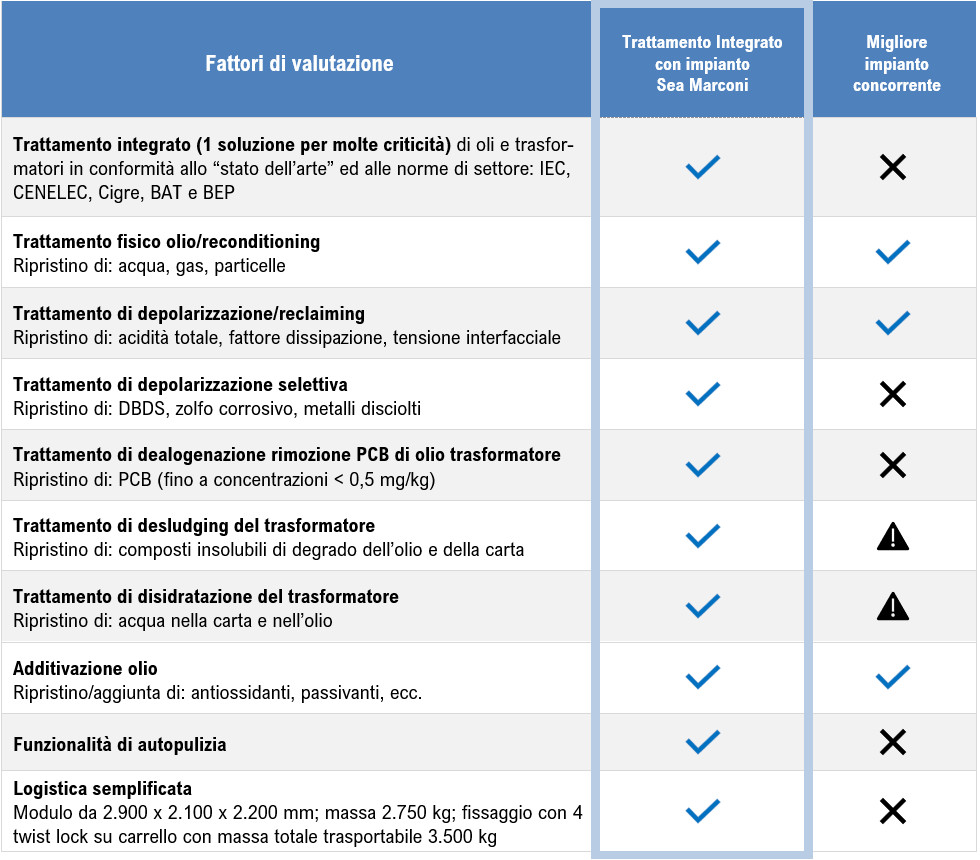
 This is the solution proposed and employed by Sea Marconi. It is a process performed on site, keeping the transformer in service (and under load) without having to empty it. The operation is carried out using a Modular Decontamination Unit (MDU) specifically created by Sea Marconi. The transformer is connected to the DMU by flexible hoses; the oil contaminated with DBDS is sucked from the lower part of the transformer and transferred into the DMU, which heats it, filters it, degasses it, dehumidifies and depolarises it before pumping it back into the upper part of the transformer. This creates a closed loop, and every time the oil is circulated, in combination with a specific setting of transformer oil temperature (> of 76 °C aniline point) it is possible to realize a continuous solubilisation of sludge in the oil and the gradual removal of sludge.
It is recommend performing this activity with the transformer in operation and under full load service by adopting specific transformer operational protocols. (read more)
Assess treatments in terms of mass balance, energy balance, emissions balance, cost-benefit, cost-effectiveness in the given time.
What are the prevention actions to be taken on electrical equipment with insulating liquids other than mineral ones?
With regard to natural ester oils and synthetic esters the therapies are the same; however, it is recommended choosing countermeasures after careful evaluation in terms of cost-benefit, cost-effectiveness and environmental impact (biodegradability and fire safety).
For silicone oils in operation, the treatments recommended by the standard (IEC 60944:1988) are “vacuum treatment and filtration” and “molecular sieves and filtration”.