To define the action priority and the choice of the countermeasures it is necessary to consider the following indicators:
Click to open
– installation of the electrical equipment;
– the financial value of the electrical equipment and the decontamination/disposal costs,
– type and quantity of insulating liquid,
– concentration of PCBs in the electrical equipment,
– state of degradation and effects on the functionality of the electrical equipment,
– possible coincidence between the decontamination activity and other maintenance activities,
– environmental impact associated with possible failures of the electrical equipment and subsequent leakages of contaminated oil.
The countermeasures to the “PCBs in oil” criticality are the result of the prescriptions and indications dealt with by:
IEC 60422 (tab. 5 page. 31);
CENELEC CLC/TR 50503 (pages. 25-26);
D.M. 29 January 2007 (pages. 42-50).
In all cases the alternatives are decontamination or the disposal of the oils and the equipment contaminated by PCBs.
Starting from disposal, the most used technique is the controlled incineration of the PCBs at very high temperature (t > 390 °F – 200 °C) with a residence time > 2 second. There are also alternative techniques designated as “non- incineration” listed here below just for a bibliographic purpose.
– Gas Phase Chemical – Reduction (GPCR); – Sodium reduction; – Base Catalysed Dechlorination; – Solvated electron; – Electrochemical Catalytic hydrogenation; – Super-critical water oxidation; – Ball milling
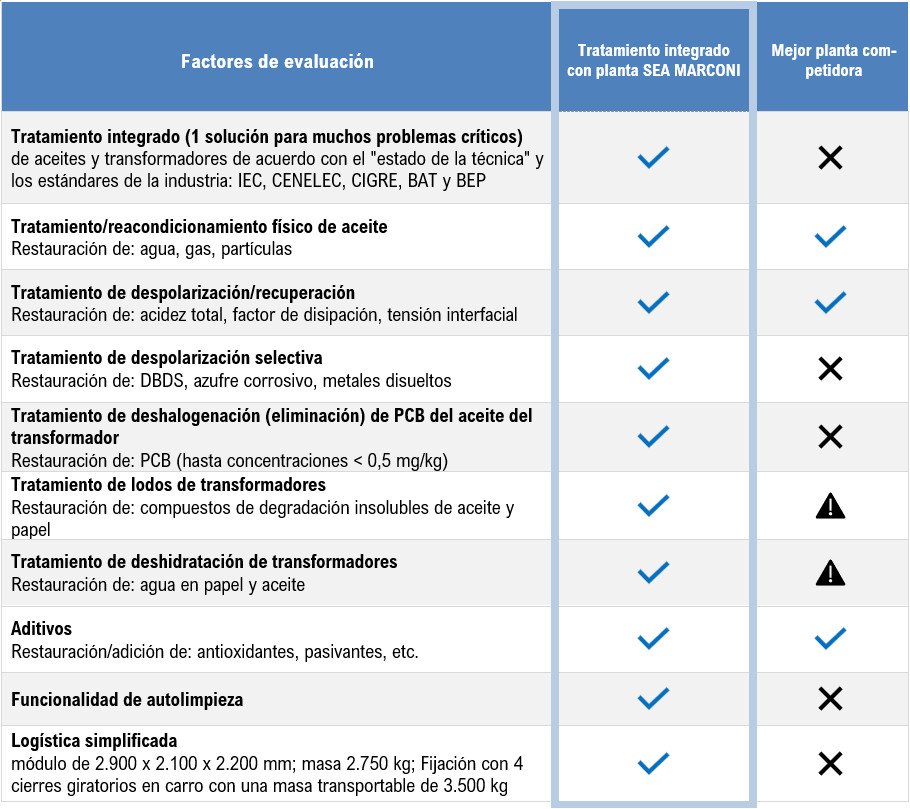
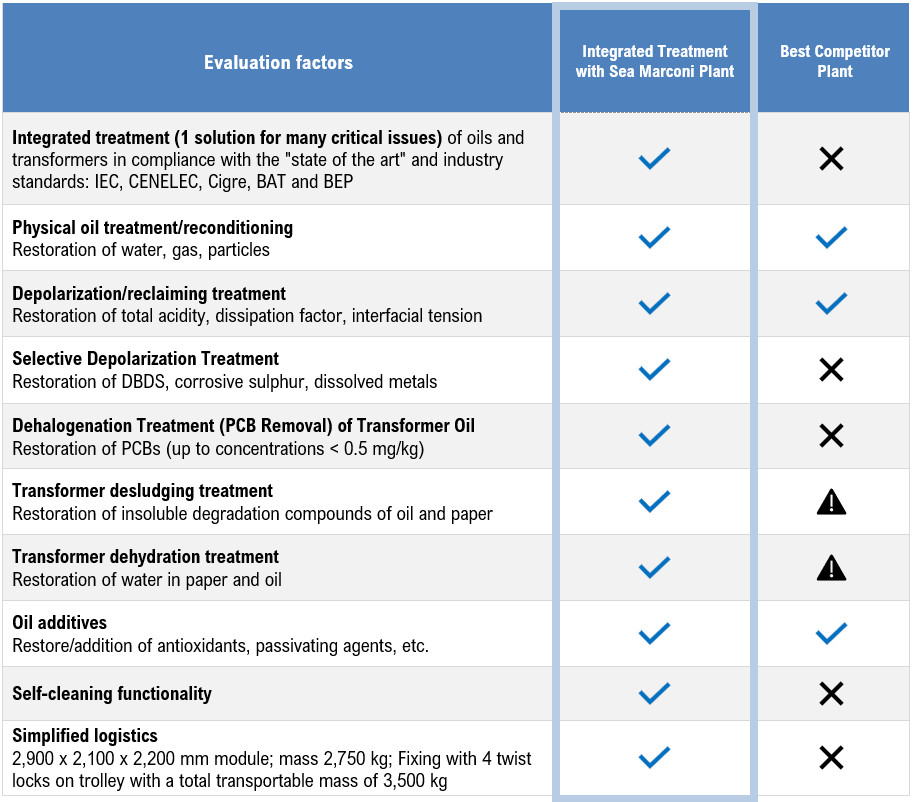
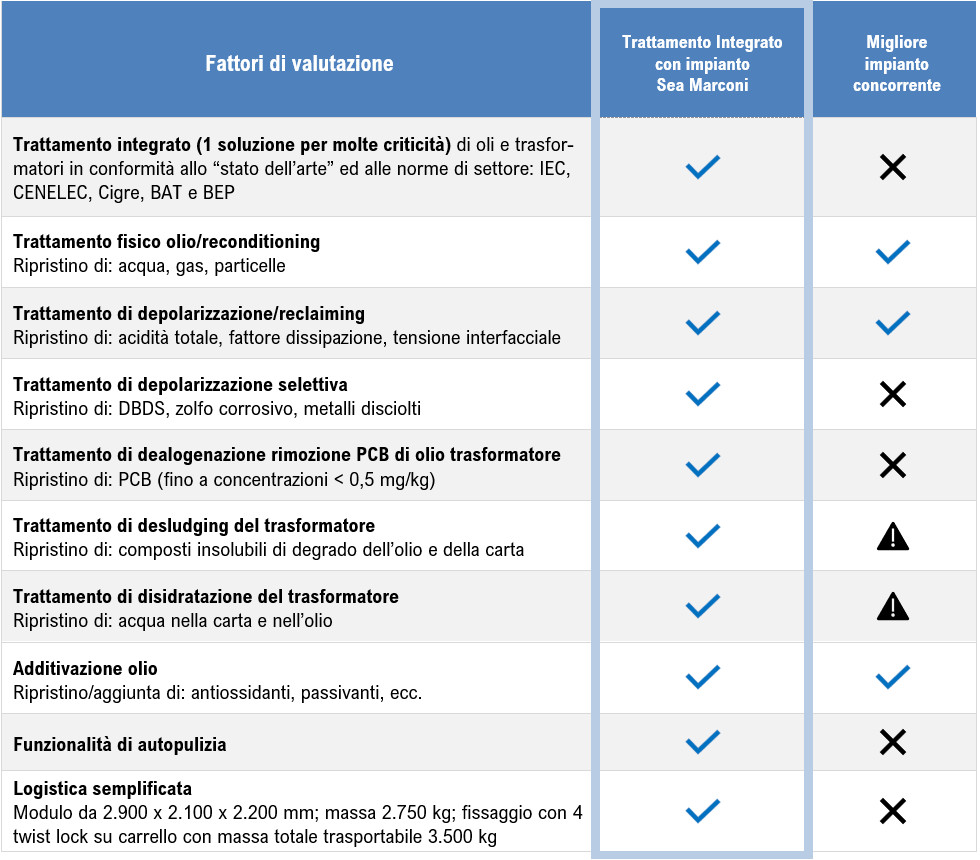
Decontamination shows many and substantial advantages with respect to disposal. First of all, decontamination provides the reclamation and recovery of the insulating liquid and electrical equipment. Under this point of view it is evident the difference in the production of wastes. Moreover, some decontamination techniques operate on site and, limited to dehalogenation, in continuous mode and closed cycle, they can be performed with the transformer in operation, providing, at the same time, the solution of other criticalities, such as for example, corrosion. For these reasons indeed, Sea Marconi prefers the approach oriented toward decontamination. Here below, the main processes for equipment with mineral insulating liquids contaminated by PCBs:
A. Changing the contaminated oil (refilling or retro filling)
Carried out in open circuit mode, it calls for the change of the contaminated liquid with contamination-free compatible with the electrical equipment.
This technique requires several passes and involves risks due essentially to the handling of large amounts of contaminated oil. (more info)
B. Process of a chemical type based upon the dehalogenation of the PCBs in the oil
They have the objective of decomposing/removing the chlorine present in the biphenyl molecule and its conversion into non-dangerous compounds with a higher bio-degradability.
B1. Dehalogenation processes with sodium, lithium and derivatives
 These processes are generally applied in batch (discontinued mode) and use reagents based on metallic sodium, sodium hydride, lithium hydride and additives, for the dehalogenation of the PCBs in the oil. This type of process is typically performed under pressure at medium-high temperatures. (150 – 300 °F 150 – 300 °C). This temperature is higher than the flash point of the oil (typically 265 – 300 °F 130 – 150 °C) thus introducing safety risks
To minimise fire and explosion risks, mostly in the presence of “wet” oil, correct measures should be implemented. In their safety cards, sodium, lithium and derivatives are classified as flammable products and this is not complying with art. 6.2 of the European Directive 96/59/EC: “keep away from all flammable products”.
B2. Dehalogenation process with polyethylene glycol and potassium hydroxide (KPEG)
B3. Dehalogenation process in continuous mode closed circuit by Sea Marconi
 This process, designated as CDP Process (patented by Sea Marconi) uses a solid reagent not mixable with oil, formed by a mixture of polyethylene glycols and polypropylene glycols with high molecular weight, a mixture of bases and a radical starter or other catalyser capable of performing a chemical conversion of organic chlorine into inert salts. This process is carried out normally at low temperatures (175 – 210 °F 80 – 100 °C) and can decontaminate the transformers (and other equipment) on site, through a continuous circulation of the oil in a closed system (without draining the transformer, even partially), exploiting the solvent capability of the oil for the continuous extraction of the PCBs from the solid materials inside the transformer. Moreover, this process has the advantage that can be carried out on-load, that is with the transformer in operation and under load during the entire decontamination. (more info)
The Italian M.D. 29th January 2007 (So n. 133 to Official Gazette of 7th June 2007 no. 130) of the Republic of Italy carried out a comparative evaluation among the different technologies available for the decontamination of PCBs based on the following factors: safety of workers, environmental safety, functional safety, eco balance and emissions, cost/benefit ratio.
The result is the following decisional matrix (table E3 page 59):
|
Functional safety
|
Environmental safety
|
Worker safety
|
Ecobalance and emissions
|
overall benefit-cost ratio
|
|
|---|---|---|---|---|---|
| Refilling | *** | ** | *** | * | ** |
| Sodium, lithium and derivatives | * | * | * | ** | * |
| KPEG | ** | *** | *** | ** | ** |
| CDP Process by Sea Marconi | *** | *** | *** | **** | **** |
The M.D. 29th January 2007 indicates among the Best Available Techniques (BAT) the CDP Process by Sea Marconi
for transformers or electrical equipment “in operation” contaminated by PCBs,
for transformers or electrical equipment “in operation” contaminated by PCBs at “end of life”
for transformers or electrical equipment “in operation” insulated by PCBs (as integration of the change of the oil)
What are the decontamination techniques for the other insulating liquids?
CENELEC CLC/TR 50503 (page 26) indicates the following processes:
– changing the contaminated fluid (in one or more cycles);
– selective adsorption on solid grounds;
– other methods with the same technical and safety performances.